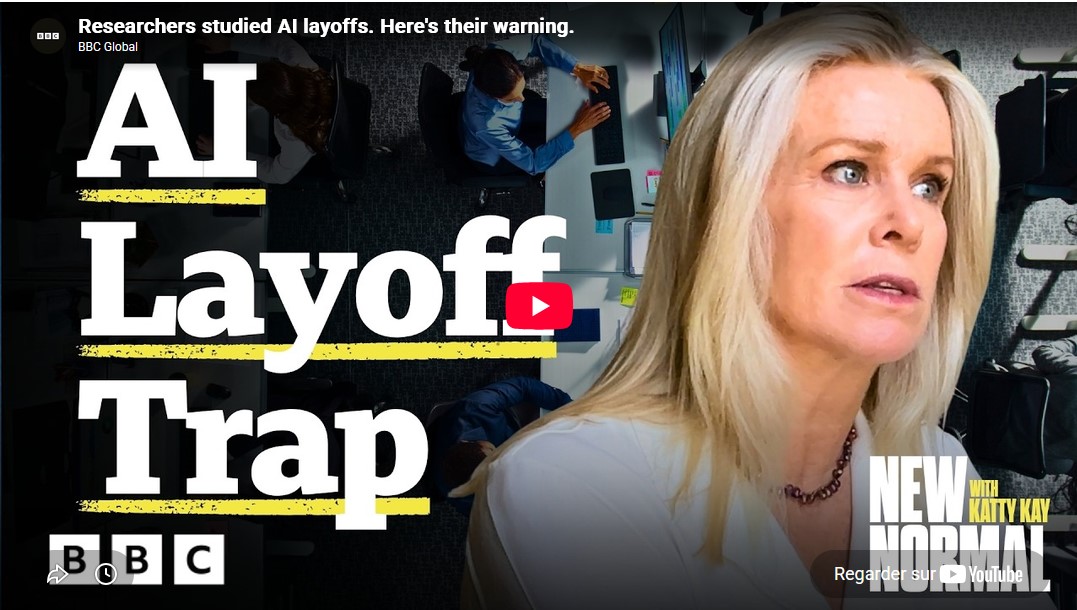
In this video, a scientist explains what impact AI will have on « human » employment in American companies, and next proposes solutions to adopt to avoid the bad consequences of this implementation.
First, he makes a distinction between the public sector, considered as the monopolistic one, and the private sector where competition is raging.
For him, the public sector won’t need to cut jobs due to AI, because as the company is in a monopolistic situation, it has no competitors, and so has no need to be efficient and cost-effective in order to face competition ; in this case the company will implement AI but in parallel will maintain the majority of jobs.
On the contrary, private companies will have to fully implement AI in the most efficient ways, and doing so, will have to get rid of the vast majority of employees. He explains that the company’s boss has a duty to do that for his shareholders, and that if it doesn’t implement AI at full potential, it won’t be cost-effective compared to competitors, and so will have to close. In this case, the virtue of keeping its employees is not well rewarded!
So the journalist intervenes and asks who in this case will consume company’s products if its employees are fired? The scientist answers that the employees didn’t necessarily buy the company’s products, and so for it, it would be a totally beneficial situation where sales wouldn’t go down, and the costs would be reduced drastically due to the implementation of AI.
At an individual level, it’s a rational and logical decision.
But, he adds, that at the society’s level as a globality, the impact will be highly and massively negative because of mass unemployment, a slump of consumption and at the end, bankruptcy of the same companies that had chosen to fully implement AI and to lay off employees.
Quite a strange situation, a downward spiral, the implosion of american society.
So the journalist asks what the solutions are to avoid this situation, given the fact that the companies won’t self-restrain themselves in adopting AI and firing people due to their competitive environment?
The expert talks about the universal income, and other solutions, but for him the best one is to tax companies that lay off employees following the implementation of AI, or to subsidise virtuous companies that keep employees despite the adoption of AI.
For him the best reference is carbon tax system : i don’t consider this as a success, so I find his solutions aren’t very useful to avoid or simply slow down the AI invasion in our lives.
Moreover, it implies state intervention, like for the breakup of oil monopolies at the beginning of the 20th century, and it necessitates a political will to regulate that I don’t see actually in America.
Finally, he tries to imagine the American society in 10 years (yes only 10 years) if nothing is made to stop the free implementation of AI and its consequences. He forecasts huge inequalities of revenues and wealth, mass unemployment, social instability at the edge of implosion and revolution : a dream society !!!
But personally, I would add that today we already see the first signs of this society in America, with huge wealth and revenue inequalities, like never seen for long (example of Musk, and High-income earners in the top 10% drive about 49.2% to 49.7% of total U.S. consumer spending, a historic high in data going back to 1989), a social instability that only translates into radicalization of American politics on both sides, democrats and republicans, but that can, we feel, overspill easily into something else.
This situation has its roots in the 2008 financial crisis during which the state bailed out the banks, and has let down mortgage loan borrowers, thereby seeing their houses foreclosed to finally lose them.
And remember movements like « Occupy wall street », and the rise of characters like Bernie Sanders or Donald Trump.
If we go on in the dystopia, we can imagine the future world if nothing is made to stop the development of deregulated AI implementation : a totalitarian society controlled by less than 10 oligarchs, wealthy beyond imagination, and surrounded by an army of AI-Robots all linked to a central Quantum computer, to suppress people’s insurrections.
So, the AI would have recreated the Middle Ages society with lords ans serfs.
In france, we had a famous movie titled « The visitors » with a lord named Godefroy de Montmirail and a shabby serf named Jacquouille la Fripouille.
So in the future AI society will you be Godefroy de Montmirail or Jacquouille la Fripouille ?
A Lord of a serf ?